Showing posts with label gravestones. Show all posts

Tuesday, April 5, 2016

QingMing in Bukit Brown (26 March 2016)

Last month I joined a tour conducted by the Brownies to Bukit Brown again. It had been quite some time I last visited Bukit Brown. This was the first time ever since the old cemetery access was not available. From the Bukit Brown website, I noted there were actually 2 entrances to the cemetery. That day the meeting point was at a platform after passing through Lorong Halwa.

(credit: Bukit Brown)


As Qingming (in fact, the actual day was yesterday according to Chinese calendar) was around the corner and the cemetery is bustling with activity again.  I joined the tour because I wanted to have a close-up look of families visiting the graves of their ancestors with offerings, and tombkeepers busy themselves with sprucing up graves ahead of the descendants' visits. I have never been to a cemetery during Qing Ming period.

Upon arrival from the bus, immediately I smelt smoke, which reminds me of the haze we had last year. This smell is pretty common especially when joss papers and offerings are burnt. Upon navigating around, I saw smoke spiraling from one spot near the bridge over Lornie Road. Someone had already paid a visit to their ancestor.
.

Besides visiting a new grave cluster, the family of Lim Chong Pang, I learnt something new on this trip.
Cars and vehicles were slowly getting into the cemetery. This road is pretty narrow. There was a jam right ahead.
Quite a number of families were seen in the cemetery that day.

2 Earth Deities?
Offerings to the ancestors, includes food, joss sticks and candles. Before these were done, the descendants have to pray to the Earth deity. This is located on either side of the tomb. (see the pair of candles on the side) Joss papers are burnt last.
I learnt, there are male and female  Earth deities (indicated by the arrow). Almost every tomb has a Earth Deity. (either the male or the female)

The male Earth Deity
The female Earth Deity
Mass Grave?
During the Japanese Occupation, it was told that there was mass grave for civilian bodies near this stream.  I don't think these bodies could survived under such a condition, unlike the those on the hills.
Busy Tomb keepers 

This period of time is the busiest time for the tomb keepers. The services they offer are quite a handful. However, during this period, they would be offering cleaning or grass cutting services before the descendants come to pay their ancestors a visit. There are families who engage their services to maintain the tombs throughout the year for a fee.

Tomb keepers in action
One of the permanent makeshift tent for the tomb keepers.
Nature
This morning, it was the first time I spotted lots of living things besides the horses. Below are just some. One of the group member pointed out there are curry leaves too!


Red dragonfly
Black butterfly
The appearance of horses made some children squealed in delight


Flowers such as chrysanthemum is being offered

A more elaborated offering.

Orchid and drinks as offering. 5 colour paper on the graves are not meant to be burnt.
过 路钱,a small stack of beige rectangular shaped paper with three holes punched onto them.are being thrown around too. It is believed to be the ‘money’ used by the deceased when they travel from places to places in the underworld. Sometimes, these were scattered on the trees. These are meant for the wandering spirits. I forgot to ask why these aren't burnt.
Linking with~

image-in-ingnew button

Saturday, May 30, 2015

More than just a cemetery - Bukit Brown

There is so much about Bukit Brown, from nature to tombs of war heroes and pioneers to even villages. My first visit to Bukit Brown was last year November. I have visited the place 3 times since. People ask what draws me to the cemetery again and again. Cemetery is not really a place I like to visit but I love the lush surroundings. How often do you find greenery that is untouched in Singapore? I also love to learn about stories about these notable pioneers who were buried here. Did you know that the Battle of Singapore also occurs here? It is really a pity the cemetery is making way for a highway and probably a new public housing town in about 40 years time. Although it is common graves to be transfer from other cemeteries to Bukit Brown due to plans for development. This time round, the graves will be exhumed as there is no other Chinese burial ground that offers permanent resting place. Hence, if Bukit Brown is gone, it is a total lost of a place with such rich heritage.

Wrought iron gate with ornaments in Art Nouveau style at Lorong Halwa
Notice of Exhumation

Hoarding around Bukit Brown

My first tour

Fascinating tree! I think it is good enough for a tree house!
Freshwater stream

Bukit Brown Cemetery was a public Chinese cemetery that had been established in the early 20th Century. It is located between Lornie Road and Mount Pleasant Road, and off Sime Road and Kheam Hock Road. The cemetery was named after its first owner, Mr George Henry Brown. Mr Brown named it Mount Pleasant. The land was then later bought by Mr Ong Kew Ho, Mr Ong Ewe Hai and Mr Ong Chong Chew in 1872 as a burial and farming ground for the Ong Clan. 

Biggest tomb on Bukit Brown belongs to that of Mr Ong Sam Leong and his wife. It tomb is clearly in view from the air. (See below) It has one of the best Feng Shui on the land. 
Aerial view of Bukit Brown. This was taken at the library when there was a Bukit Brown exhibition.
The then Municipal Commissioner Tan Kheam Hock established Bukit Brown as a municipal cemetery (1922) for the Chinese community for both the rich and the poor . Kheam Hock Road was which leads to Bukit Brown is named after him. The Kheam Hock Road Village, located  in the northern part of Kheam Hock Road is one of the villages that existed in the cemetery. Today, you can make out remnants of the village if you look hard enough.

Remnants of the village
Clockwise from Bottom left: The old village toilet, The same toilet and  a well of the village, A fresh water stream, Further down the stream with a stump beside it marking house number

A view from one of the paths (Taken during Tour 1)
Same site as above.
Some of the tombs have private gates around them as boundaries. Some tombstone are simple. Some are more elaborated,
(Taken during Tour 2- Preparation for Qing Ming- grass were cut)
After Qing Ming (Tomb Sweeping), coloured papers were spotted. (Tour 3)

Some of the tombs have a very obvious boundary. - by pillars as in far left.  The more elaborated the tombstone the more influential or wealthy the deceased was.
A typical tombstone would include inscriptions such as:
  1. The name of the deceased at the centre
  2. Place of birth
  3. The date of birth & death. (though normally only the date of death is engraved)
  4. The names of the spouse &/descendants of the deceased
All the graves have a Earth deity located near them. Earth deity is commonly believed to be the guardian of graves, protecting the deceased in the netherworld and the providing with the descendants with a good life. It is usually perpendicular to the grave and it is the size of a few bricks in most tombs.
Love these Peranakan tiles used for decoration. The Earth deity is located in front of this tomb, perpendicular to it.

    Here is a tomb of a rectangular grave mound, not of the usual rounded shape which are spotted in majority of  Bukit Brown .
    Grave of Mdm Yeo Boey Neo 
The graves found here are predominantly Hokkien style. The grave mound of the deceased is usually encircled by a boundary, often lined with bricks. (Hence we do not step onto the grave mound  This is seen as an act of disrespect to the deceased) The reason being the Hokkien is a larger community in Singapore and probably because Bukit Brown started as an Ong (who are Hokkien) Clan cemetery. The other reason being, most of the tomb makers serving Bukit Brown are Hokkien and hence, that could also be the reason that the graves of non- Hokkien, tend to follow the Hokkien style.


Difference between a Hokkien Style Grave and a Teochew Style Grave


A Hokkien style grave  with 3 names engraved. Notice there are 2 photos instead of 3. This could be because Bukit Brown is closed for burial since 1973.  Hence, the third person is not buried here.
Look at the Terracotta sculptures depicting the armies of Qin Shi Huang, the first Emperor of China. Phrases of poems were engraved on all the 4 pillars
Prominent pioneers as well as the not so prominent pioneers found their resting place here.
Dr Lim Su Min, a descendant,  playing Ukelele at the Tomb of  Mr Tan Kim Ching, son of Mr Tan Tock Seng.
Mr Tan Kim Ching was a philanthropist and leading Chinese merchants in Singapore, he was also Consul of Japan, Thailand and Russia, as well as a member of the Royal Court of Siam. Kim Ching Street was named after him. His tomb was originally buried in  a private burial ground in Changi before relocation to Bukit Brown
Tomb of Mr Cheang Hong Lim , a philanthropist and Chinese community leader.,
(located just in front of Tan Kim Ching's tomb)
Places named after him include Hong Lim Park,  Hong Lim Market, Cheang Wan Seng Place, Cheang Hong Lim Street

He was originally buried in  his family grave located off Alexandra Rd -Mei Ling St.
Tomb of Mr and Mrs Cheang Jim Hean , eldest son of Mr. Cheang Hong Lim
Mr Cheang Jim Hean was originally buried in his family burial ground at Alexandra.
Unique tomb of Mr Tan Boon Cheng. A tomb within a wooden shack with quite a number of dogs guarding it

Tomb of Mr Lee Hoon Leong, our late Minister Mentor Lee Kuan Yew's grandfather

Sculptures such as these were seen in Bukit Brown

as well as beautiful Peranakan tiles

Not forgetting the Battle for Singapore...


If you are interested in Bukit Brown, do sign up for their regular guided tours which is conducted every first weekend of each month. Do check out their website for different tours as well.

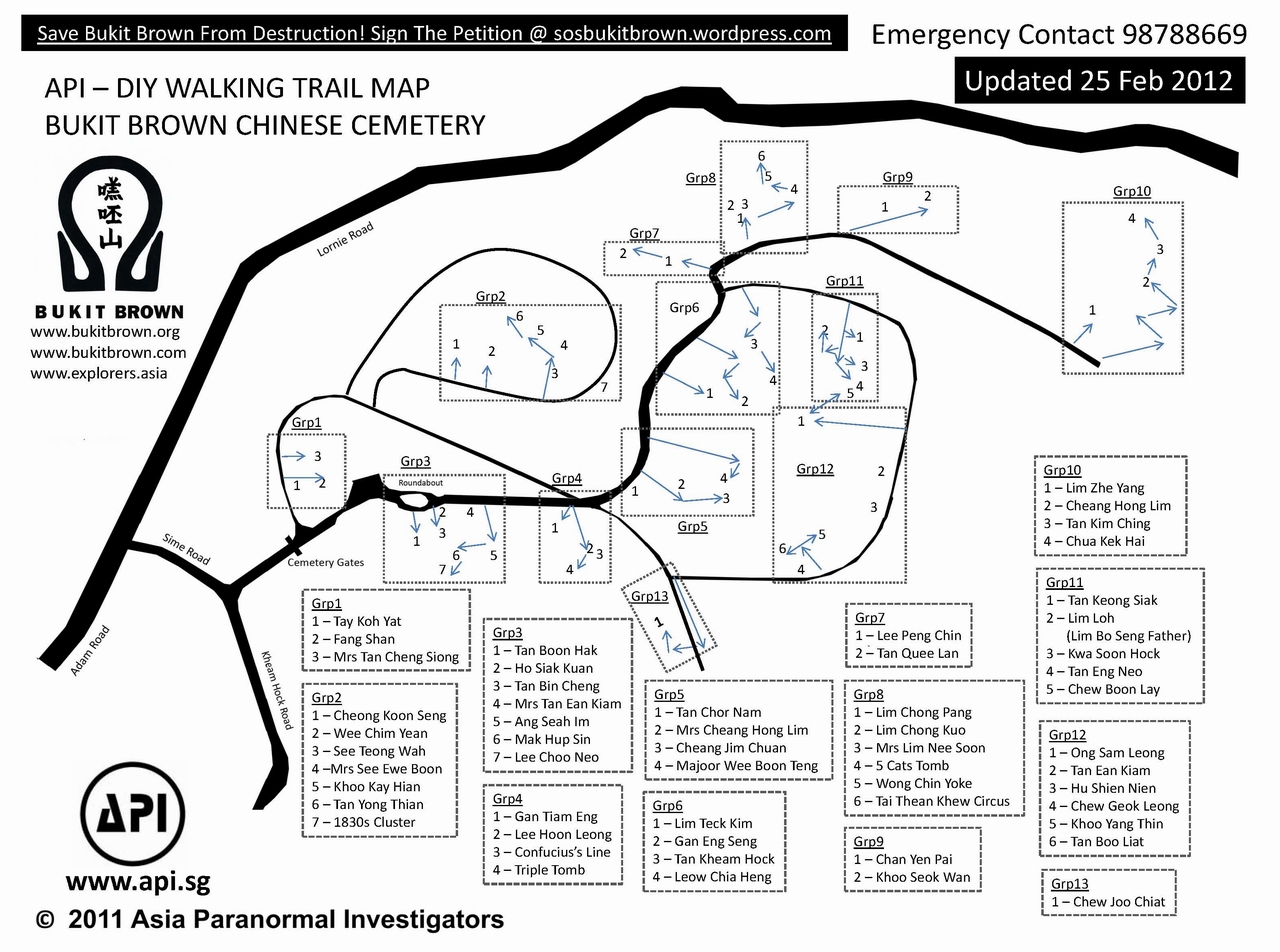
You may want to conduct your own DIY tour using this map but not to wander too far in the terrain for safety reasons. 
Related Posts Plugin for WordPress, Blogger...