Showing posts with label monument. Show all posts

Thursday, May 19, 2016

Hidden Gem in Telok Ayer: Singapore Musical Box Museum

As a child, I have always loved musical box. The soft melody and the sight of a delicate little ballerina that would swirl and swirl around in a small jewel box that my mother used to own. I remembered winding the box up again and again just to listen to the music and watch the ballerina twirl. I believe no one can resist the magic of a musical box. My little girl was exposed to musical box in a form of a train 3 years ago. She , too, loves musical box.

Organised in conjunction of the Singapore Heritage Festival (SHF), we registered with Singapore Musical Box Museum to enjoy a free admission as well as tour. The trip was a truly eye opener! I did not know that they come in all sorts of sizes. The 2 wonderful guides explained to us the history and evolution of musical boxes. I am totally impressed! I believed those who are with us were too!

Singapore Musical Box Museum

The Singapore Musical Box Museum is the first of its kind in Singapore.  Although the museum was opened in Nov 2015 to the public, I was not aware of its existence until this SHF. Its founder is a Japanese collector Mr. Naoto Orui. He moved his collection from his Minamichita Music Box Museum in Mihama, Japan, to Singapore. Many of these exhibits are his collection. Currently, there are over 40 of them in the museum.

Music boxes are similar to the chime mechanism of old clocks.
The museum is not huge but nevertheless, it is fascinating! The first part of the tour is about cylinder music boxes. These are made of a revolving cylinder with pins on it. The cylinder would be spinned and at the same time, it plucks the pins of a comb to make music. Some of these have interchangeable cylinder to play different music in the same musical box. In the early days, only the super wealthy could afford to have musical boxes as they were expensive. The cylinders with the pins had to be man made.

Mandolin Tremolo Zither (Switzerland)  1880s.
Left: Roller Gem Organ (USA)1885 reminds me of a typewriter
Right:Musical box with storage drawers
Next session, we were introduced to  the disc musical boxes,  German music box artisan Paul Lochmann created discs instead of cylinders. Discs can be mass produced, unlike cylinders of the time, which had to be hand made. Thus, disc music boxes can be made for a much lower cost and be brought to more people to enjoy.

Below  is a Polyphon Table Model Style 45. (Germany)1890s

Doesn't this reminds you of a vinyl player?
Left: How a  punched disc looked like
Right: Other Disc musical box include a Britannia
Then, we explored the coin slotted musical boxes, these are giants! They are as big as a grandfather's clocks. They need antique coins to operate. Modern coins does not work on them. They are that specific.

"Atlantic" - an orchestral musical box
It was to go into the Titanic, but they wanted a larger box on it, and this went to the Atlantic instead. It has parts of a piano ,  bass drum, snare drum and even a triangle.

Giant cylinder of the "Atlantic"

Polyphon Giant Music Box

This is a precursor of the jukebox! Look at the number of disc it has! Yes, you can choose which song you want it to play.
"China" made in Singapore
Are you surprised to know that Singapore manufactured musical box as early as late 1800s? I am! The guide explained that as Singapore was under colonial rule, the British had taught Singapore craftsmen how to repair watches and clocks. Subsequently, when musical boxes were brought into the country, the same craftsmen would repair and maintain, eventually going on to make the musical boxes themselves.

I wonder what tune would "China" play. Unfortunately, it is still waiting for restoration.

If you wonder, why it was named "China", we were told, during the colonial time, any place in the East was considered China. Hence, this piece of work is consider that from China.

"China"

Limited edition scarf by Hermès made in 1996 and a musical cigar holder in front.

The musical cigar holder. It's mind blowing that people use musical for almost anything, not just for pure entertainment.

The guides even ask us to take a look at the architecture of this place. 

View of Chong Wen Ge Pavillion, Thian Hock Keng and Singapore Yu Huang Gong temples
 Chong Wen Ge was the first education institution set up by the Chinese community in Singapore. Thian Hock Keng Temple is Singapore’s oldest Chinese temple. Both gazetted as national monuments in 1973.

"Chong Wen Ge In the past, two institutions flanked Thian Hock Keng: Chongwen Ge (崇文阁, ‘Institute for the Veneration of Literature’), Singapore’s first Chinese school; and Keng Teck Whay (庆德会), a private Straits Chinese self-help association. In 1849, an outstanding Hokkien Peranakan merchant, Tan Kim Seng (陈金声), spearheaded the construction of Chongwen Ge. Besides the Hokkiens, members of the Hakka and Teochew communities also contributed generously to the project. Originally, Chongwen Ge comprised the Chongwen Pagoda and Chong Boon Gate. Chong Hock Pavilion was added in 1913.

Having outgrown its facility within the temple grounds, Hokkien Huay Kuan moved into Chong Hock Pavilion in 1915. That same year, it established Chong Hock Girls’ School (崇福女校), one of Singapore’s earliest Chinese schools for girls. The name ‘Chong Hock’ (崇福) was an honorary title given to Mazu in the imperial court during the Song Dynasty (960–1279).

Thian Hock Keng Today

The temple remains an important place of worship among local Chinese Buddhists and Taoists. Between 1998 and 2000, Thian Hock Keng underwent a major restoration which earned it an honourable mention in the UNESCO Asia-Pacific Heritage 2001 Awards for Cultural Heritage Conservation.

Thian Hock Keng and Chongwen Ge were gazetted collectively as a National Monument."
 - Roots ( NHB)

Thanks to SHF, both Little One had an educational tour on musical boxes. It is amazing that musical bozes that were 2 centuries old are still functioning today! A tip from the guides to maintain the music boxes is to play it often. 

Also in Chong Wen Ge is Peranakan Tile Gallery. If you are a tile lover, do check this place out! It opens daily from 12-5pm.

Look at those lovely tiles and the mirror , of course! My favorite is the peacock and plenty,  plenty more!


If you are in Telok Ayer, do consider paying this place a visit. They have a gift shop too!

Singapore Musical Box Museum
Operating Hours : 
Mondays, Wednesdays-Fridays:10am-6pm
Saturdays: 10am-5pm
*Closed on Tuesdays, Sundays & Public Holiday

Address : 168 Telok Ayer Street, Singapore 068619 - Next to Thian Hock Keng Temple

T: +65 6221 0102

Ticketing information:
Adults : S$12.00
Students (with valid student pass) S$6.00*
Seniors (60 years and above with valid ID) S$6.00*

*For Singapore citizens and permanent residents only
For more information, visit their website.
Linking with~

image-in-ingnew button

Wednesday, April 27, 2016

A Lion Salute

As part of Ma Zu Dan, Singapore Hokkien Huay Kuan had invited Nam Sieng Dragon and Lion Dance Activity Centre Singapore to perform various acrobats, lion dances and dragon dances at Thian Hock Keng temple whose main deity is Ma Zu. My personal favorite is lion dance on poles. And yes, they performed that last night! It was quite an eye opener.

Who is Ma Zu?

She is a female goddess, protector of sea voyagers. She is also known as Tian Hou.
It was said that she had the power to predict weather and often warned people of bad weathers and advised them not to make journeys to the sea. She was a good swimmer and was able to save people even in the harshest weather. 

Ma Zu Dan
Ma Zu Dan refers to Ma Zu's birthday-festival. It is on the twenty-third day of the third lunar month of the lunar calendar. It falls in late April or early May according to the Gregorian calendar.

About Thian Hock Keng

Thian Hock Keng Temple is a 176 year old monument. It is one of the oldest and most important Hokkien temple in Singapore. In the past, Chinese immigrants who had just completed their journey across the turbulent South China Sea to Singapore ,would make offerings of money and joss-sticks here in Thian Hock Keng as thanksgiving. 

Thian Hock Keng Temple

28 lions were here to salute the goddess. They went into the temple and out again.

That was followed by dragon dance.


2 rows of lion heads

Big Flags performance

These flags are almost ad long as the parade square and are quite heavy. The performers are able to balance them on their head,  arms, fists and even using their mouths.

Stunts like this was displayed. With the occasional wind, the flags almost fell, it can be quite a scare.

Another stunt

Drum performance.
Wushu 
My favorite segment : Lion dances on poles.

Such performance definitely require experience and skills. Some of the poles are place more than 1.5 meter apart! It is hard to jump 1.5m alone. What more together with a companion!
Lion stunts on poles

Linking with~

image-in-ingnew button

Wednesday, April 13, 2016

10th Anniversary at Goodwood Park Hotel

My hubby and I just celebrated our 10th Anniversary at Goodwood Park Hotel, a 5 star hotel in Singapore. I had requested hubby to take leave for a celebration.

As Little One was in school in the morning, we had some "We Time" together having brunch, haircut and walking around in the Financial District. We have not been doing this frequently except during Chinese New Year when hubby's company shuts down. This is one great time to bond again together.

After school, we brought Little One to Goodwood Park Hotel. We chose to celebrate in Goodwood Park because this place is special to us. We held our ROM reception at the Coffee Lounge 10 years ago. As we walked towards the hotel, I felt my heart pounding exactly it was 10 years ago. I was butterfly excited and kept talking to Little One about her parents' wedding then. We wanted to share this memory with Little One. It made her anxious to see the location too!
Tower Block of Goodwood Park Hotel
Prior visiting, we actually watched a video which my brother in law took on that important day! How we have aged! Although some guests that we knew does not seemed to age much, the most obvious change were that of the children. They have grown from chubby toddlers to lean children! The oldest is already in Secondary school! How time flies!

Goodwood Park Hotel
When we talk of Goodwood Park Hotel, everyone reminded of the famous durian pastries. For those who loves durian, this is a must go place. Enough of durian, do you know the tower block is actually a monument of Singapore (Gazetted on 23 September 1989)?

"The Tower Wing of the present-day Goodwood Park Hotel was home to the German Teutonia Club, one of the earliest European national clubs in Singapore. It is a prominent landmark in the Orchard area for its unique architecture. The charming structure serves as a reminder of the Germans’ contributions to trade in early colonial Singapore, and of the impact of the First World War on the local German community. Goodwood Park Hotel is also a monument to the flourishing hotel industry in Singapore during the colonial period and beyond."
                                                                                       -NHB

The tower block was home to the German Teutonia Club in 1900.  It was designed by architect R. A. J. Bidwell of Swan and Maclaren in the Queen Anne style (a mix of Dutch, French and English influences that was popular in England in the nineteenth century.) The main features of this architectural style include brick pediments, towers, verandahs, and detailed textures – all of which can be seen in the building’s design. The front stairway leads up to the main entrance, which is topped by the impressive turret-like tower and flanked by two gable walls with semi-circular pediments covered in elaborate mouldings of leaves, flowers, and ribbons. Blocked architraves and rusticated walls add texture to the monument. It has a striking tower, the building included electric lighting installations that were considered advanced for its time.  The Teutonia Club was the centre of German social life in Singapore.

Gable wall with semi-circular pediments covered in elaborate mouldings of leaves, flowers, and ribbons.
Good times at the Teutonia Club lasted until World War I. The British government in Singapore classified all Germans as enemy forces and shipped most of them to Australia. The Teutonia Club was then seized by the Custodian of Enemy Property.

In 1918, the building was sold at public auction to the Manasseh brothers, Morris, Ezekiel and Ellis. The building was converted into a reception hall known as Goodwood Hall. In 1929, the Manasseh brothers converted the establishment into a full-fledged hotel and renamed it Goodwood Park Hotel.

In 1942, the hotel was converted into a residence for high-ranking Japanese soldiers. After the end of the Japanese Occupation in 1945, the hotel became the site of the British War Crimes Court, where more than 100 Japanese war criminals were tried and convicted.
Main entrance


The hotel resumed its operations in 1947 with the British army handing the building back to the pre-war owners. In 1963, the hotel was bought over by the Malayan Banking Group, and then by billionaire banker and hotelier Khoo Teck Puat in 1968. Now the hotel is owned by the Khoo family.


Back to our anniversary celebration, we went straight to Coffee Lounge. By that time, the Local High Tea Buffet had already started. (3pm) We did not make any reservation, we just walked in. The place was different from 10 years ago. It used to have the restaurant name on the wall but I could not find it any where now.

It has a buffet spread with more than 20 popular local snacks, mains and desserts. Little One loves the Ang Ku Kueh while both my hubby and I love the chwee kueh. We find it very delicious especially the chye poh is pleasantly sweet. I remember having the mee siam 10 years ago and I think it tasted the same as before.

Local High Tea Buffet
After the high tea, we were absolutely full. We decided to buy some durian puffs home. These are absolutely delicious.
Not forgetting to get some durian puff from Deli.

Sources:
http://www.nhb.gov.sg/places/sites-and-monuments/national-monuments/goodwood-park-hotel-tower-block
http://eresources.nlb.gov.sg/infopedia/articles/SIP_767_2004-12-15.html

Linking with~

image-in-ingnew button

Thursday, August 6, 2015

Vanda "Miss Joaquim" and the Armenian Church


Who is Vanda Miss Joaquim?
In case you are wondering, who is Vanda Miss Joaquim. That is Singapore's national flower (selected in 15 Apr 1981), an orchid, named after the Miss Agnes Joaquim (7 Apr 1864 - 2 Jul 1899). The flower is a cross between Burmese Vanda teres (pod parent) and the Malayan Vanda hookeriana (pollen parent). It is a hardy flower and free flowering. 

The Vanda Miss Joaquim was selected from among 40 flowers, out of which 30 were orchids, as Singapore's national flower. This makes Singapore the only country to have a hybrid as her national flower. Among the several varieties of Vanda Miss Joaquim, the variety "Agnes" was chosen particularly for its vibrant colours, hardiness and resilience - qualities which reflect the Singapore spirit. Its ability to bloom throughout the year also won the judges over.


At Istana near the Villa

Buckill Hall at National Orchid Garden

Agnes Joaquim
Miss Agnes Joaquim, an Armenian, bred it and the plant was taken to taken to  H. N. Ridley, the director of the Singapore Botanic Garden at the time, who first described the hybrid plant in the Gardeners' Chronicle on 24 June 1893.

Agnes Joaquim won prizes at annual flower shows and famously won the prize for the rarest orchid at the 1899 annual flower show. The first prize was for a hybrid that was named after her, Vanda 'Miss Joaquim'. However, already suffering from cancer then, she died soon after receiving this prize.

Besides gardening, she was also an active member of the Armenian Church and a skilled embroiderer.

Agnes was the eldest daughter and second child of a brood of 11 of Parsick (Basil) Joaquim, an Armenian merchant and commercial agent. Their family had an illustrious history of contributions to the Singapore community, beginning with Agnes' father's philanthropy towards the general community.

Friday, May 22, 2015

Little One @ Former Command House

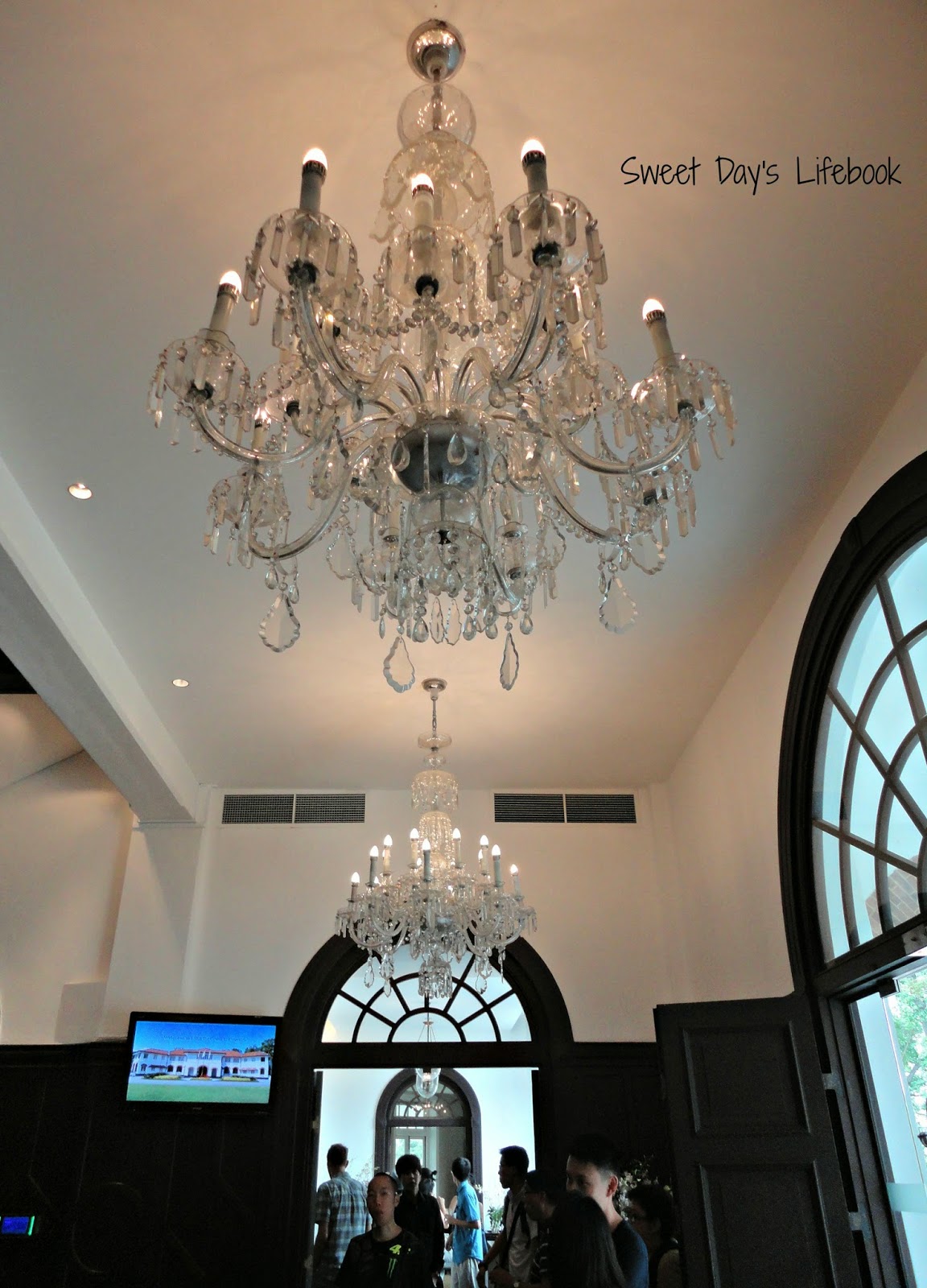
Usually, I will not bring Little One along for Heritage walks as she tends to disturb talk to me when the guide is talking. This time round, I had no choice because Hubby was serving his National Service. However, I was glad to bring Little One here because of her love for chandeliers and this place has lots of them. The place is so grand that she enjoyed herself very much exploring around that day. Our guide was a staff member of UBS.

Located at 17 Kheam Hock Road is the UBS Wealth Management Campus. It is a training and conference facility designed to train, develop and certify UBS employees and clients in the Asia Pacific region. Not many would have know that this is the Command House. It was the official residency of the British General Officer Commanding (GOC) of Malaya. It was known as the Flagstaff House then. It was the second Flagstaff House in Singapore. The first Flagstaff house was located in Mount Rosie before the GOC moved over to this building.
The Former Command House is well hidden from view if you are standing at the gate.

The $100,000 Flagstaff House occupies 11.5 acres area of land, on the west side of Kheam Hock Road leading to Sime Road and the Singapore Golf Club (now the Singapore Island Country Club), was completed in August 1938. It was the residence of 16 British military officers, a Speaker of Parliment and a President. It was rented to UBS in 2007 and was gazetted as a monument in 2009. The campus is not opened to public and hence it is a rare opportunity to be able to visit the place during this special heritage tour.

Former Command House
Command House is a two-storey brick structure which includes six bedrooms. Apart from the main building stand three blocks that were originally servants’ quarters. The building was designed by architect Frank W. Brewer. He was being influenced by popular Arts and Crafts architectural movement which emphasised traditional workmanship, simple forms, exposed materials, and folk or medieval styles of decoration. Example of influences of the Arts and Crafts movement found in this building are the distinctive butterfly plan ( where two or four wings of a house are constructed at an angle to the wall of the main building), the combination of roughcast plaster rendering and the facing brickwork with arches for external building facades.
The butterfly plan lay out is most clearly seen from the front of the building

Roughcast plaster finish and facing brickwork with arches.

The building is designed for tropical living, and features a large overhanging roof as well as large doors, windows and vents that allow good cross-ventilation.

Little One wowed by the chandelier as soon as she entered the building. Note the 2 vents above the mirrors and that of the door for cross ventilation? The door actually leads to a staircase all the way to the second floor of the left wing and the ground level of the right wing.
I can't help but notice these bars. I asked our guide but she is not sure why these were installed. They were already there when they rented the building. I noticed the same structure at Goodwood Park Hotel.
Before I touch on the Singapore government occupants of the building, allow me to inform you some WW2 history. I am not sure whether the guide brief on this but we did go to the washroom.

By December 1941, the area surrounding Flagstaff House was known as Sime Road Camp, a military base that included the Royal Air Force Headquarters. GOC Lieutenant-General A. E. Percival, who was in charged of the army, and  Air Vice Marshall C. W. H. Pulford had established the Combined Operations Headquarters of the British Army and Air Force. It was from the Headquarters that Percival commanded the Malayan Campaign against the Japanese and the battle for Singapore.  On 11 February, as Japanese troops were drawing near, command operations were moved to the bunker at Fort Canning (now known as the Battle Box), and Sime Road Camp was abandoned. 

During the Japanese invasion, the Sime Road area near Flagstaff House was the site of heavy fighting. After Singapore fell to the Japanese, Sime Road Camp became an internment camp when more than 3,000 prisoners of war were transferred there in May 1944. while the Flagstaff House was used as the Japanese soldiers’ quarters.

At entrance, towards left wing. Love the chandeliers!


Related Posts Plugin for WordPress, Blogger...